Goal, Objectives, Strategies and Tactics

From the APR Study Guide:

Goals:

Goals are longer-term, broad, global and future statements of “being.” Goals may include how an organization is uniquely distinguished in the minds of its key publics.

Example: To become the recognized leader in our industry and foster continuing public support.

Publics:

Publics are groups of people tied together by some common element. Before starting to plan, public relations practitioners need to clearly define groups with which an organization needs to foster mutually beneficial relationships. Objectives need to say which public a public relations strategy is designed to reach.

Objectives:

(from this IPR whitepaper) Management guru Peter F. Drucker said, “Objectives are not fate; they are direction. They are not commands; they are commitments. They do not determine the future; they are means to mobilize the resources and energies of the business for the making of the future.”

Objectives focus on a shorter term than goals. Objectives are written after research on all publics is done. Objectives (1) define WHAT opinion, attitude or behavior you want to achieve from specific publics, (2) specify how much change you want to achieve from each public, and (3) tell by when you want to achieve that change. Objectives should be SMART:
• Specific (both action to be taken and public involved)
• Measurable
• Achievable
• Realistic (or relevant or results (outcome) oriented)
• Time-specific

Objectives establish standards for assessing the success of your public relations efforts. Objectives come
in three general types:
• Output objectives measure activities, e.g., issue 10 news releases during the month or post three tweets per day. Outputs can help monitor your work but have no direct value in measuring the effectiveness of a campaign. The Barcelona Principles discourage the use of output objectives.
• Process objectives call for you to “inform” or “educate” publics.
• Outcome objectives specify changes in awareness, opinions, behavior or support. (For example, “Increase downloads of our product coupon by 25 percent from October levels by Dec. 31.”) Outcome objectives require high-level strategic thinking. You must determine, for instance, which changes would be consistent with organizational goals and demonstrate public relations effectiveness to management. (For example, a fundraising objective may be more appropriate for a nonprofit organization’s annual gala than an attendance or awareness objective.
The group’s board is likely most concerned about raising money.) “Differentiate between measuring public relations ‘outputs,’ generally short-term and surface (e.g., amount of news coverage, number of blog posts) and measuring public relations ‘outcomes,’ usually more farreaching and carrying greater impact (changing awareness, attitudes and even behavior)” (Seitel,2001, 145).

(from PR Couture) Tips for writing PR objectives

  • Start with an action verb – words like increase, reduce, improve, maintain work well
  • If you are using “by” you are writing a strategy, not an objective. Try again.

Are these good or bad objectives?

  • To help humankind
  • To add $1,000,000 in PR-attributable sales in the new year
  • To secure 15 blog posts on UK-based style blogs within 2 months (via PR Couture)
  • Raise awareness of “cleaning power” among women 25-34 from 20% last year to 50% this year.
  • Create an understanding of insurance pricing models by the end of the campaign in November.
  • By the end of the year, convince 10% of customers that bank fees are an acceptable charge.
  • To raise awareness for the Foundation’s signature fundraising weekend through earned media placements and social media activation in order to drive event ticket sales, increase total amount raised for children’s charities and increase awareness for the Foundation’s overall mission

Strategies:

Strategies provide the roadmap to your objectives. (Communication strategies target publics for change. Action strategies focus on organizations’ internal changes.)
• Strategies describe HOW to reach your objectives.
• Strategies include “enlist community influentials to …,” “accelerate involvement with …,” “position the company as …” or “establish strategic partnerships with … .”

Broom and Sha define strategies as “the overall concept, approach, or general plan for the program designed to achieve an objective.”

Strategies connect objectives to tactics, or “the events, media, and methods used to implement the strategy.”

From PR Couture (again):

Tips for writing PR strategies

  • Use action verbs like Develop, Create, Promote, Target, etc
  • Did you just write Develop a look book to….. sorry kitten, strategies do not include the “to” phrase. The “to” in this case is to meet the stated objective. The stinker.
  • Also omit your tendancy to use “by” – as in “Promote my brand by developing a look book to – that look book you are all amped about? That, my friend is a tactic. What you DO with that look book is your strategy.

Example:  Promote Lottie Lingerie through personalized pitches to 50 UK-based style bloggers

Tactics/tools:

Tactics are specific elements of a strategy or tools for accomplishing a strategy.
• Examples include meetings, publications, product tie-ins, community events, news releases, online
information dissemination and social networks.
• Activities are details of tactics: six meetings, four publications, three blog posts and one tweet per
day. Activities have dates, indicate who is in charge and tell what attendance or outcome is expected.
Media Releases for Today’s Assignment

Group 1:

Frank’s® RedHot® Invites Everyone to Join Live Spin the Bottle Game on Sunday, February 2nd

Group 2:

adidas And Beyoncé Launch The adidas x IVY PARK Collection: 

Group 3:

NAFSA: Coronavirus Travel Ban Impacts International Education

Group 4:

The Princeton Review Has Released Its “Best Value Colleges” List and Rankings for 2020

Group 5:

Move Over Cupid, Baskin-Robbins is Stealing Hearts this Month

Group 6:

Study: Singles Are Over The Pressure Of Valentine’s Day, Say It Should Be #Canceled

Group 7:

Censorship on Coronavirus Imperils Public Safety, States Association of American Physicians and Surgeons (AAPS)

Group 8:

To-Dos for Desktop Publishing

Class,

We’ve made significant progress. But we still have some things to do for your client and in this class.

Side note: I saw Dr. Evans (the university president) last night. He mentioned your class project and what you were doing to help the Recruitment/Admission area, and he is excited to see what you have done.Let that be your motivation for the remainder of the class.

To-Do #1

If you have not submitted your empathy map, please do so immediately. Send it to ntindall@lamar.edu

To-Do #2

Now that you have the persona, layer on secondary research about that public/target audience. Pull at least 10 key facts about your group from the resources below. (These are places to start. Look widely in the databases available at Lamar and online via Google Scholar.)

To-Do #3:

Next, you will need to work on page 3 of the handout that I gave you Tuesday. Work on the message and elevator pitch. Now that you know what you know about people who are at LU, what can/should we tell freshmen from your target audience about Lamar?

Regarding your messaging, it does not have to be perfect.

To-Do #4:

Type up the data from the handout and your key facts. Send to me by the start of Tuesday’s class.

Articles and References for Sept. 26 Cardinal Conversation

Critical Race Theory

Critical race theory (CRT)[1] is a theoretical framework in the social sciences that uses critical theory to examine society and culture as they relate to categorizations of racelaw, and power. (from Wikipedia)

CRT recognizes that racism is engrained in the fabric and system of the American society. The individual racist need not exist to note that institutional racism is pervasive in the dominant culture. This is the analytical lens that CRT uses in examining existing power structures. CRT identifies that these power structures are based on white privilege and white supremacy, which perpetuates the marginalization of people of color. (UCLA School of Public Affairs)

Yosso: Whose culture has capital? A critical race theory discussion of community cultural wealth

Hiraldo: The role of critical race theory in higher education

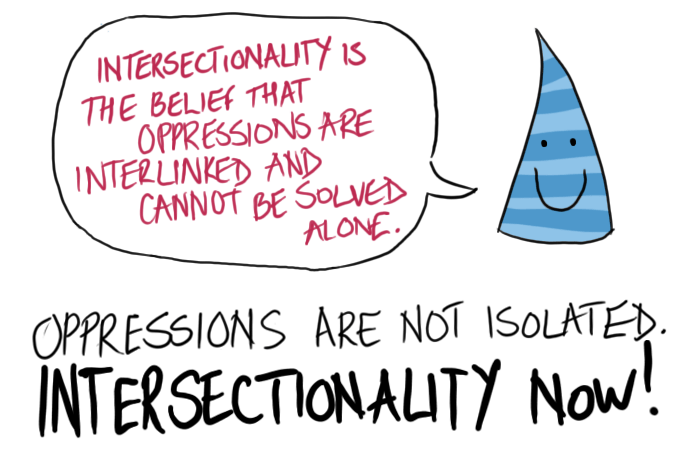
Intersectionality 101

A fun, illustrated guide to intersectionality: https://miriamdobson.com/2013/07/12/intersectionality-a-fun-guide-now-in-powerpoint-presentation-formation/


bobslide6

Kimberle Crenshaw

Screen Shot 2019-09-25 at 3.26.07 PM

Applications

“Most students like me enter higher education through its windows, only to find that all around us are walls that keep us secluded and marginalized.” (Rendon, 1992, p. 55)

Women of Color Faculty in Academia

I am located in the margin. I make a definite distinction between that marginality which is imposed by oppressive structures and that marginality one chooses as site of resistance-as location of radical openness and possibility. (hooks, 1990, p. 153)

I teach as if I have nothing to lose, which helps me tell my students the truth—about why the faces in the room are mostly a certain color, or about how we are all part of an oppressive structure perpetuating all sorts of bigotry just by sitting in that room. I don’t believe these institutions will figure out a way to solve their own problems. They were designed to do the opposite. When I speak at other predominantly white campuses, I remind the students of color and the women about this fact: This place never imagined you here, and your exclusion was a fundamental premise in its initial design. I push students to make themselves heard, to voice their understandable and justified rage. Then I go back to my own campus and sit in my office and listen to the lights buzz overheard while thanking the universe that, for now, I have health insurance. That contradiction makes me sick. And the only thing that eases the nausea is the writing. The writing asks you to question the job. The job lets me afford the writing. The job is why you’re reading this. (Capo Crucet, 2019)

LGBTQ Faculty in Academia

Inclusive Workplaces

Screen Shot 2019-09-25 at 3.48.46 PM

Serving Diverse Communities

Desktop Publishing Assignment for Sept. 5

Adapted from page 7 of your textbook:

Use research, writing, and design to put data in action by developing a simple, three sign infographic on one of the topics below. You should perform research on government, academic, or nonprofit websites to gain meaningful statistics on your topic…

Write a one-line description that clearly states what the statistic is about and who is affected by what it represents.

Next, find an image that explicitly makes meaning of who is affected in an iconic way (represents it) and an image that makes meaning in an indexical way (points to it).

Place the numbers and images together to create an infographic on Microsoft Word.

Send your final draft to Dr. Tindall via email.

Sources for photos and icons

Sources for the statistics you should use for these topics: 

Hunger 

Homelessness

Poverty


Income inequality

Climate change


Desktop Publishing Class Notes (Sept. 3)

Lecture Notes — September 3 Desktop Class

Signs (Wikipedia Page)
Visual Rhetoric (Wikipedia Page)
We live in a world of multimodal texts.
Roland Barthes called “text” the tissue “worked out in a perpetual interweaving.
Text
Document
A work
Icon — clear representation of things
Index — points to something
Symbol/word — abstracts something
5 modes of communication:
Linguistic
—use of language, written or spoken words
—word choice, delivery, organization into phrases, sentences, paragraphs
—Development and coherence of individual words and ideas
Visual
—color
—size
—layout
—style
—perspective
Aural
—sound
—music
Sound effects
Ambient noise
Silence
Tone of voice
Volume of sound
Emphasis and accent
Spatial
==physical arrangement
—how does a brochure open and the way it leads a reader through the text
—the way a classroom is arranged
—arrangement
—organization
—proximity between people or objects
(Website for favorite retail, entertainment or news site: Notice how spatial mode is used. Where is your eye drawn? How are the elements of the page laid out? What effect does the spatial arrangement have on how you read, use and understand the information?
Gestural
—facial expressions
-hand gestures
—body language
—interaction between people
(Why does this matter for online and print?
5 modes are a set of tools — each mode has its own strength and weakness
Texts need to be created for a purpose, to persuade an audience to change in some way.
Rhetorical situation — set of circumstances in which the author creates a text
4 factors:
audience
Purpose for communicating
Context in which the text will be read
The genre they choose
Look at the university web page. It serves many purposes. What information is emphasized on the from tpage. Why is that the case? What does it say about the primary intended audience? What does the university assumed this audience is looking for? D you see more info that sells the university than you see standard university information? Why do yours this matter when it comes to the purpose of the home page for a university?
In sum, Semiotics is the “science” of signs and design is the “art” of making signs.