Pop Culture + PR: Meek Mill and Image Repair Strategy

This blog post isn’t to rehash what happened between two rappers. Billboard does a nice summary of the beef/problem and how it escalated from a tweet to an epic takedown at a concert: http://www.billboard.com/articles/columns/the-juice/6641784/meek-mill-drake-timeline

I joked on Twitter as Drake was modulating a straight diss via PowerPoint presentation: “What is Meek Mill’s image repair strategy? Will Drake suffer from the velcro effect?” This should be a grad student’s PR research paper.

Alas, no one took me up on this offer, so I decided to write-up a quick analysis. Here’s my quickie analysis. Both of these guys are celebrity brands within a certain niche of pop culture, and what transpired between them–a feud or a beef–happens with some of the companies and brands we use every day (e.g., Krispy Kreme vs. Dunkin Donuts, Arby’s vs. Everybody, Google vs. Yahoo).

Based on what I learned and saw, I typed up a few key propositions that I would give to any client if it was involved in an online or real-life brouhaha.

Proposition 1: Watch what you tweet.
This is basic PR 101. Every brand has learned this at some point. Meek Mill did not. Sometimes you need to leave some things unsaid online. Sometimes you have to leave some tweets in the draft folder and/or walk away from the inbox/@ column before you say unkind things. Meek should have done that.

Proposition 2: The meek shall inherit the earth, but they damn sure don’t win rap battles.
Meek win because his team didn’t think strategically. They had a series of bad tweets and a poorly executed diss track. Against Drake, one of the best rappers in the game right now with reach and pull. Sir Meek, you brought a paper clip to a nuclear war.

Proposition 3: Steal thunder when you can.
As a brand and as a strategist, you need to know when to steal thunder and culture jack a situation to your benefit. Drake did that. Take note of how he did that. He jumped ahead of the Meek Mill comments about alleged ghostwriting. Review the memes Drake rapped in front of. (He crowdsourced his diss, using user-generated content to exemplify his stance.) Review the two tracks Drake pushed out. (He capitalized on the moment to showcase his writing and flow skills and critique Meek Mill’s ghostwriting claim.)

Proposition 4: Image restoration would have worked early in the game.
Now Meek Mill is basically a carcass on the road of hip hop. He had the opportunity to stop assess where he was and pivot back to sanity, high record sales, and Nicki Minaj’s arms. His team could have examined the available image restoration options. Timothy Coombs offers a cogent, thoughtful explanation of these strategies and options here: http://www.instituteforpr.org/crisis-management-communications/
Unfortunately, Meek didn’t pause and reflect. He chose to not make an apology and “take full responsibility for the crisis and asks stakeholders for forgiveness.” That’s not what happens in rap battles due to ego, masculinity, and sheer bone-headedness. He didn’t have to even use the term apology because that might sound soft. He could have squashed this with a simple call or face to face meeting or, in the classic Jay-Z/Nas way, by meeting on stage and declaring a truce. (Tangent: The best diss track I’ve ever heard is Nas’ Ether. To learn more about the Jay-Z/Nas beef, check out the Wikipedia page dedicated to it.) He continued to charge and now he is the butt of jokes and is watching his career opportunities spontaneously combust.

Proposition 5: There’s not much Meek Mill can do except burrow in a hole and reconsider his life choices.
After a crisis, a brand or person may need to step out of the spotlight and do some assessment, asking questions like:
a. What are the attitudes and behaviors of my fan base? Would they still be interested in the products I have?
b. Is my reputation velcro or halo?
c. Has the word of mouth communication about me died down?
d. Should I consider a career in gospel rap?
e. Can I be a house husband to Nicki? Would she let me help her with her lyrics?

Seriously, in a real crisis with an actual company or brand, the first three questions are applicable. It behooves all practitioners and publicist to think about a fluid crisis strategy, as advocated in this Cision post. As for Meek Mill, I doubt that he even cares anymore, but he should.


Internship Opportunity: Marketing/Communications Intern, The Boys & Girls Club of Metro Atlanta

INTERNSHIP: The Boys & Girls Club of Metro Atlanta is looking for a marketing/communications intern.

Internship responsibilities include:
1. Creating and posting content on social media platforms
2. Drafting content for print and e-mail communications
3. Updating the BGCMA website
4. Assisting in media relations, including writing press releases, media advisories and pitches to media, and much more.

Interested students should e-mail their resume and writing samples to aleon@bgcma.org.
Thank you to Black Public Relations Society of Atlanta for sharing this internship opportunity.

How to write 1000 words a day (and not go bat shit crazy)

Thesis Whisperer's avatarThe Thesis Whisperer

Recently I Tweeted a link to an article called “How to write 1000 words a day for your blog” which I thought had some good productivity tips for thesis writers. @webnemesis wrote back: ” would like to see someone write a blog post on how to write 1000 words of substance for yr dissertation every day”. Of course I answered: “Challenge? Accepted!”

When I was nearing the end of my PhD, I added up the number of words I had to write and divided them by the number of days of study leave I had left. Then I freaked out and had to have a little lie down. According to my calculations I had to write 60,000 words in 3 months.

After a  cup of tea (with maybe just a whiff of scotch in it) I contemplated this problem and made a PLAN, which was cobbled together from all the advice books on writing I…

View original post 929 more words

Poverty in the Ivory Tower

Sarcozona's avatarTenure, She Wrote

This post is a modified and expanded version of a post that originally appeared on my personal blog.

I went to an awesome small conference a few years ago. The location was gorgeous, I got my own room, the talks were all well prepared and about stuff I’m gaga over. There were enough acquaintances attending to feel comfortable and enough new folks to make some useful connections. Plus, the conference sponsors gave away lots of free and super nerdy books.

I also got to interact a lot more with two postdocs from my university who I had developed little science crushes on and really admired. When I prepare for discussion groups, I try to work through the material as deeply as they do. When people ask me questions, I try to respond as carefully and thoughtfully as they do. When they say a book really impressed them, I go…

View original post 2,208 more words

The Wrap Up for July 20, 2015

Cision: Build your brand on Instagram

“being active on Instagram ensures you’re a part of this big party. But also, so many brands are struggling with how to use or aren’t using it at all, so for those of us on there, we can build our communities, grow our presence, and establish a foundation before everyone else catches on and are left playing catch-up. Instagram is a hyper-rich site for engagement too. With engagement rates 15X greater than Facebook and significantly higher than the other major social media sites, there is real opportunity to connect with and build a devoted audience on Instagram.”

Social Media Today: Yik Yak adds ability to add photos

Whether you use it or not, whether you know it or not, Yik Yak is a social app that’s on the rise, with close to two million monthly active users. Anyone marketing to younger consumers needs to be aware of Yik Yak – and now the app has added a new photo functionality, enabling users to share images to accompany their yaks – so long as those photos don’t contain anyone’s faces. But how will Yik Yak possibly be able to enforce such a restriction? Now that’s an interesting challenge.

Time: Stop trying to achieve work-life balance

At its heart this implies we should trade one aspect for another, compromising as we go. To me this trimming of excess in one area to prop up another serves to remove, not create, meaning.

The other argument that Whyte surfaces penetrates the fabric of our human needs: the constant tug of war between our social desires and our need for space. This is another area where we naturally try to find balance and in so doing compromise part of ourselves.

PR Daily: Five infographic tools for PR and marketing pros

Infographics are 30 times more likely to be read than a text article sharing the same information Tall images (with lengths of 800 pixels or more) are more popular with Pinterest users, as well, says Dan Zarrella, social media scientist at Hubspot.

Though it makes sense that these visuals are engaging—your fans would rather look at the data instead of reading paragraphs about your findings—finding and creating infographics can be daunting. Luckily, there are terrific resources.

Vitae: Ignore your haters and toot your own horn

Those who dismiss self-promotion are generally those whose privilege effortlessly promoted them. Walter’s study suggests that for many men, self-promotion is so natural and automatic that it doesn’t rise to the level of discussion. For the rest of us, however, it’s essential not only to do it, but to teach one another how to do it. Self-promotion is critical to the academic career at this point in time, and I encourage you to ignore the haters, and toot your own horn for all the world to hear.

AdWeek: 4 recommendations (and 1 calculation) to improve social media engagement

Marketers often have a spectrum of goals for their Facebook pages. From growing awareness to converting Fans into email subscribers, many marketers make progress on each of these goals by focusing on a strategy of building overall community engagement. To aid in this goal, here are four key ways to improve overall Facebook engagement and a great way to calculate average engagement.

Medium: The pink ghetto of social media

How do these statistics play into the culture of the newsroom? As a possible explanation, Taylor Lorenz, a social media strategist and editor, says that in her experience “women are not encouraged as much to get into hard news.” Similarly, many other social media editors who work in the industry (some of whom wish to remain anonymous) describe the perception that social media is a “girly job.” One woman notes a vibe of “let’s give this easy job to a girl, she can handle it” around the office; that social media is seen as easier, “fluffy,” and not on par with other editorial roles. Even though it’s no secret that social media is critical to the current business models, one woman who works as a social media editor in news thinks “the position is always gonna be viewed as some dumb 20-year-old woman job.”

Hootsuite: 5 social network features you need to stop ignoring (Twitter-favorites; Facebook-interest lists, LinkedIn-search for posts, Instagram-the following tab, Google-Google analytics snapshot)

Like certain spices in every rack, social networks have features that we simply pass over without giving them much thought. Sometimes we use them, but often as an afterthought with no strategy behind it. But these features were carefully thought out and built. They serve a purpose, a place in a recipe that many of us simply haven’t discovered yet.

99U: How to avoid miscommunications and email like a real human being (Add empathy to your emails.)

Chris Balttman: The UCLA sexual harassment case that every professor should be aware of (This is something every professor should be aware of.)

CFP: “Breaking the Rules” Special Issue for Case Studies in Strategic Communication

CASE STUDIES IN STRATEGIC COMMUNICATION (ISSN 2167-1974)

Call for Papers: Special Section on Breaking the Rules

Guest Editors: Peppercomm and Natalie T. J. Tindall, Ph.D., APR

Every now and then, an organization acts in a way that seems surprising or unusual at the time, yet these decisions are celebrated in hindsight for breaking new ground or setting new trends in the field. “Risky,” “out-of-the-box,” “game-changing,” “paradigm-shifting,” and “edgy” – these cases somehow break the established rules of strategic communication, enduring as exceptional and memorable one-off examples or spurring entirely new research questions and new ways of thinking in the profession.

This special section of Case Studies in Strategic Communication aims to assemble such a collection of misfits and stand-outs that defy the normative best practices of strategic communication and question established theory and research. These cases include consumer product launches that incorporated consumers in innovative ways; companies throwing large-scale events on shoestring budgets; the use of guerilla advertising tactics that pushed the envelope; pioneering deployments of new technologies; and organizational responses to crises that defied conventional best practice. Cases should emphasize the transformative, the unusual, and the forward-thinking execution of strategic communication in real organizational contexts. Also, cases should strive for the clear articulation of ideas that those external to the academic conversation can grasp easily and for the balanced integration of theory and practice, all to achieve with the end goal of articulating theoretical insights an!
d pragmatic application.

Timeline

Completed manuscript submission deadline: September 10, 2015

Decisions: October 19, 2015

Final versions of accepted manuscripts due: November 9, 2015

Anticipated publication date: November 2015

Submit manuscripts to Sam Ford at sford@peppercomm.com. All manuscripts should conform to the journal’s Instructions for Authors. All other inquiries about the journal can be directed to csscjournal@gmail.com.

About Case Studies in Strategic Communication

Unlike most scholarly journals, CSSC’s primary focus is not to test or advance theory. Rather, CSSC welcomes case studies that can be of use in the classroom as teaching tools or used by practitioners. All cases should be based on real events and organizations.

CSSC is an online, peer-reviewed, open access journal published by Annenberg Press at the University of Southern California. There are no fees to submit, publish, or read articles. For more information about the journal, visit http://www.csscjournal.org.

The Wrap Up for July 12, 2015

Here are the curated links I think will be useful and valuable for your work and your life:

My apologies, dear readers, for missing a week. Blogging slipped my mind while I was gorging on birthday cake, fried fish, and popsicles. Thanks to the 4th of July and my birthday, I was juggling multiple engagements. But I’m back to blogging for awhile.

The Wrap Up for June 28, 2015

Tools, Tips & Tricks

Industry Insights

Et cetera of interest

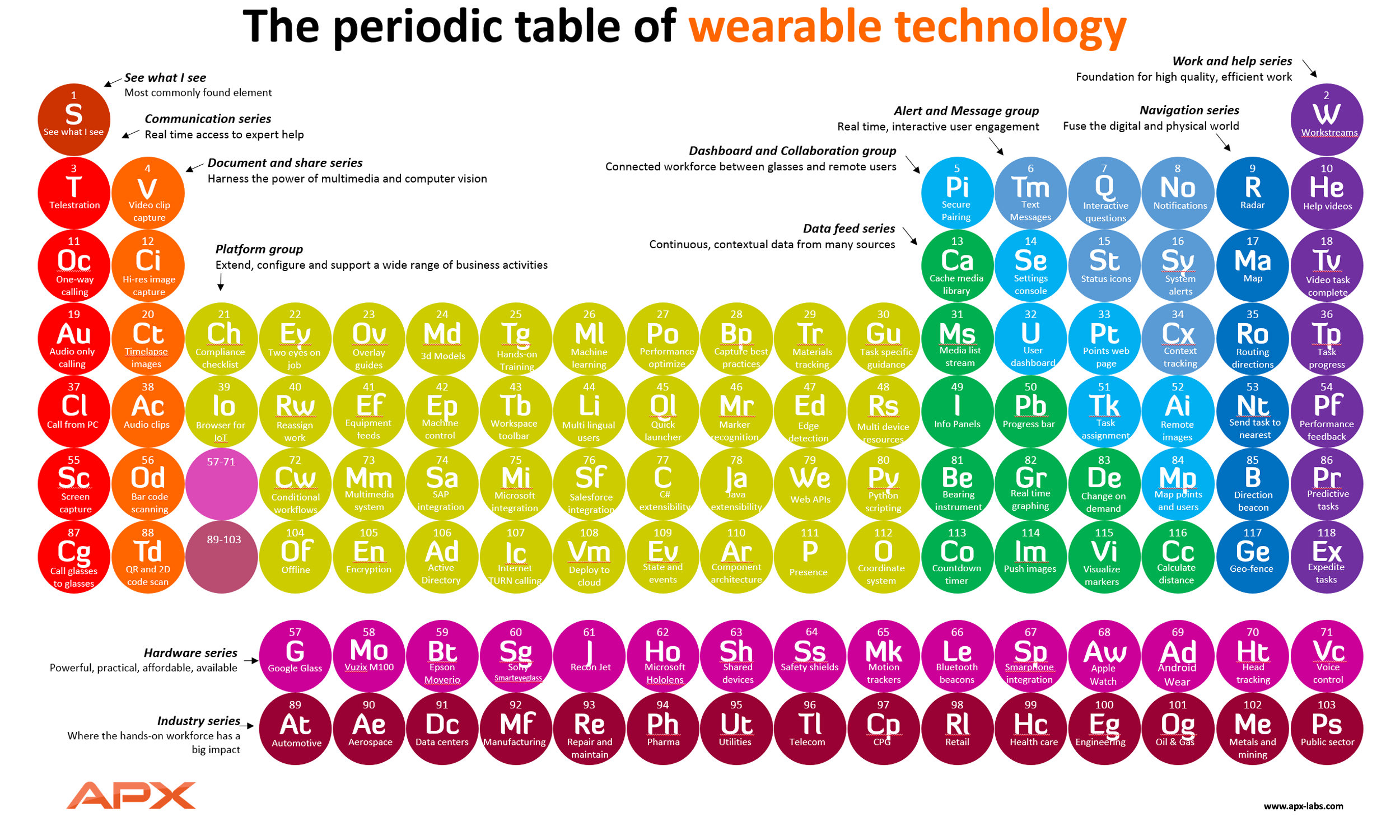
Find of the Week: The Periodic Table of Wearables

apx-periodic-table-of-elements

Picture it: Grant Park, 2 p.m. at Octane Coffee. I am sitting down over tea and iced chai tea lattes, talking social media strategy when a client pulls this up on her laptop. As someone who enjoys rainbow colors (especially today in the United States), the periodic table, and wearable tech, I was excited.

APX Labs, creators of the chart, described it this way:

Our updated periodic table groups and defines the main capabilities that businesses are using today to build and harness a connected workforce.

Individually they are powerful, but when you combine them together they create solutions that are impossible to deliver in any other way.

Brian Ballard, the co-founder and CEO of APX Labs, goes into more detail about the different categories in a TechCrunch article. Some choice quotations from that piece:

We used the periodic table to extract a framework and put some organization around the huge surface of wearable technology. Each item in a color-coded group is related to each other in some important way, just like the real periodic table. Instead of atomic number and chemical properties, we use value-prop and underlying technologies. […]

One of the true differentiators between wearables and other traditional devices is their ability to operate in the real world, understanding location, capturing rich context and making decisions around all that. We’re finding new and novel uses for these wearable tech elements every day. It’s exciting to see how smart glasses, smartwatches and other peripherals are being used to change the practical, day-to-day activities of people in different industries.

What do you think about the periodic table? What ethics should users, practitioners, and creators think about when developing or using these technologies?

Teaching Job Opportunity: Technical Communication Lecturer Position for 2015-16, Georgia Tech, Atlanta

Dear colleagues,

Please see the job announcement below for a teaching opportunity in an innovative team-taught tech comm/computer science course at Georgia Tech.

Questions can be directed to me (andy.frazee@lmc.gatech.edu) or Rebecca Burnett (rebecca.burnett@lmc.gatech.edu).

Many thanks,

Andy

Andy Frazee, PhD
Associate Director of Writing and Communication
School of Literature, Media, and Communication
Georgia Institute of Technology
andy.frazee@lmc.gatech.edu

JOB POSTING: Technical Communication Lecturer Position for 2015-16

————————

Team teach with computer science faculty in year-long junior capstone classes of sections linking computer science and intro tech comm. Face-to-face and hybrid teaching related to client-based projects. Degree in tech comm or rhetoric preferred but comparable experience considered. Research opportunities. ABD applicants considered. Nine-month appointment with the equivalent of 3:3 load.

This position is within Georgia Tech’s Writing and Communication Program, a unit of the School of Literature, Media, and Communication and home of the Marion L. Brittain Postdoctoral Fellowship. The Writing and Communication Program oversees courses in first-year composition, research writing, and technical communication, all of which emphasize rhetoric, process, and multimodality. For more information, see http://wcprogram.lmc.gatech.edu/ and http://lmc.gatech.edu/

Please submit letter of application, CV, teaching philosophy, and three letters of recommendation. Apply immediately to hiring@lmc.gatech.edu. Review of complete online submissions will begin July 10, 2015 for teaching in August 2015. The Georgia Institute of Technology is an equal opportunity employer whose academic core mission is based on the principles of inclusion, equity, diversity, and justice.