Public Affairs Intern, CTIA-The Wireless Association, Washington, DC

Public Affairs Intern, CTIA-The Wireless Association, Washington, DC


PUBLIC AFFAIRS INTERNSHIP PROGRAM


DESCRIPTION:

CTIA-The Wireless Association (www.ctia.org) represents the U.S. wireless communications industry. With members from wireless carriers and their suppliers to providers and manufacturers of wireless data services and products, the association brings together a dynamic group of companies that enable consumers to lead a 21st century connected life. CTIA members benefit from its vigorous advocacy at all levels of government for policies that foster the continued innovation, investment and economic impact of America’s competitive and world-leading mobile ecosystem. The association also coordinates the industry’s voluntary best practices and initiatives and convenes the industry’s leading wireless tradeshow.


Headquartered in Dupont Circle in Washington, DC, CTIA is offering one college student (undergrad or graduate) or recent graduate the opportunity to gain experience working for a dynamic trade association.


CTIA’s Public Affairs team works with our Regulatory Affairs, Government Affairs, External and State Affairs on many policy issues. We also work with the industry’s non-profit organization, The Wireless Foundation, on various matters.


The intern would be an integral part of the Public Affairs team, assisting with tasks including coordinating and staffing events, writing press releases, writing blog posts, developing online content and tracking industry-focused news and events.


REQUIREMENTS:

Applicants must have completed their junior year of undergraduate study and have at least a B average. Applicants studying from all major areas are welcome, but academic or practical backgrounds in journalism, mass media, communications, public relations, public affairs and radio and television broadcasting are preferred.


COMPENSATION AND HOURS:

Interns should be available at least 4 days a week and for at least 25 hours per week for college credit only.


APPLICATION:

Please send a cover letter, including your availability (start dates and weekly schedule), resume, three different writing samples (no more than 3 pages each and should demonstrate concise writing ability), two letters of recommendation and college transcript to: CTIAMedRel@ctia.org or


Public Affairs Intern Application

CTIA-The Wireless Association

1400 16th Street NW Suite 600

Washington, DC 20036


Applicants must be available beginning in January to May 2016. All application should be in CTIA Public Affairs’ office by December 11, 2015 at 5 PM ET.


Incomplete applications will not be considered. No phone calls please. CTIA will contact candidates directly. Decisions will be made within 1-2 weeks of the application deadline.
A Response to the Washington Post article, “It’s 2015. Where are all the Black college fy aculty?”

Here is the article if you haven’t read it.

Black faculty are here. We’re not mythical unicorns.  Some are the walking wounded. Some are the successful few who have navigated the university politics to make it to full. Some black faces appear in the slick university brochures. Others toil behind the scenes, not quite sure if they are noticed and hoping that they aren’t.

But we are here. You might not see us for the following reasons:

We’re probably in diversity meetings called by the dean or provost that will lead to nothing but lost time and increased aggravation.

We’re probably frustrated and marginalized. We’re probably not on tenure track.

We might be in a hiring committee meeting, only to see certain candidates declared as “not a good fit for the department.” We might be asked to recruit people of color to apply for these faculty lines to “get our diversity numbers up.”

We could be seeking out other professors of color on campus, just to see a friendly face or another brown or black face on campus. And many of us fail at that task.

We’re probably working with the students of color who were left behind in the graduate program because they considered deficient by faculty. We’re sponsoring and mentoring those who were left to wither on the vine.

We might be mentoring an endless stream of students who seek you out because you are a safe haven. We keep tissue, petty cash, candy, and a good word tucked away at all times just in case one of those students need it.

We may be grinding out the service work that counts for nothing but takes up so much time. We didn’t volunteer for this committee, but somehow we’re on it. We might be told by a department chair that since we’re good at that administrative stuff that we are a good fit for time-intensive, labor-filled service that will amount to one line of the CV and no goodwill from those making merit, tenure, and promotion decisions.

We probably aren’t focused on research as much as we like because of that other stuff. If we are research focused and we happen to do work on our community, we’re probably being told that it isn’t enough for tenure.

We’re likely dealing with classroom issues that have to deal with being black, being black and female, or being black and queer or disabled in the classroom.

We might be dealing with the structural racism, sexism, and other -isms that prop up the academy and dealing with the physical and mental toll that wears your body down.

We’re here, but we are occupied.

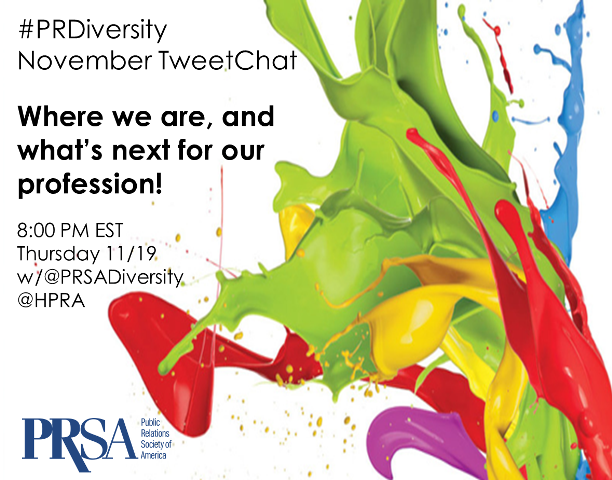
#PRDiversity November Tweetchat

‪#‎PRProfs‬ and #PRstudents, the Public Relations Society of America (PRSA) Diversity and Inclusion Committee and the Hispanic Public Relations Association are hosting a ‪#‎PRDiversity‬ Twitter chat on Thursday, November 19, at 8 p.m. EST. Share the word. Join in and tell your students to get involved in the conversation about what is the current state of diversity in the field.

diversity tweetchat

Diversity in Public Relations: It’s 2015, and we’re still talking about this?

A draft of this blog post sat in my box for months. I didn’t want to write this, but conversations at the PRSA International Conference made me feel like it was necessary to write this post.

I feel like I have talked about diversity in public relations for eons. That’s not true. It’s only been since I started graduate school at the University of Maryland that I began noticing and talking about the lack of diversity in the industry. That was 10+ years ago. Yet here we are in 2015 (almost 2016) still talking about this issue.

Example 1: This PRWeek cover of mostly white practitioners who are the top leaders of PR agencies frustrated me and others. As Shonali Burke points out:

A strong example of this can be seen on PRWeek’s 2014 Agency Business Report. While the publication’s effort to celebrate PR leadership and their innovation year after year is notable, it’s hard to ignore the lack of diversity on the front cover, which featured the most senior leaders at the top 13 agencies by revenue and the top two agencies by revenue growth in 2013.

While the decision to publish Caucasian-only faces as “PR leaders” may have been unintentional, the message conveyed is clear: “PR leaders” do not include people of color, minorities or of different ethnicity. At least not in 2014; and 2014 wasn’t light years away. It was just one year ago.

Scary. And sad.

Example 2: The release of the State of the PR Industry report from the National Black Public Relations Society. One of the claims that ran a chill down my spine was the fact that professional desire to have a sustained interest in career growth and advancement, yet do not have access to sponsors or see others like them in larger key roles. Breaking through is an obstacle course made up of glass ceilings, sticky floors, and porcelain/ceramic vaults because practitioners are contained in limited roles, have not moved beyond mentorship into sponsorship relationships, and are not exposed to new clients or new business opportunities. Dr. Rochelle Ford and Dr. Clarke Caywood bounced these findings off the work of Applebaum, Walton and Southerland (2015) and Hewlett and Green (2015).

Although the players have changed and the outlets where this matter is discussed have morphed, the conversation is still the same. The industry isn’t diverse. The industry has a retention problem. The industry has a recruitment problem. The industry has a problem. The industry should do something about it. The industry should start something to reverse these trends.

It’s the same verse of the same hymnal, sung by the same members of the choir to other members of the choir. We just change the riff and add a new falsetto every few times. I just hope that people from the congregation (our PR peers across all sectors and organizations) hear the choir, feel something swell up in their souls, and start to do something meaningful. As someone from Texas once told me, “they align the tongues in their shoes with the tongues in their mouths.”

I doubt that will happen until there is a sudden shift or movement. There must be something that jostles the industry out of its soporific stupor about diversity. A stringent call to action against the cognitive biases that frame and shape who gets into the door and who get asked to climb up the corporate trellis. A gauntlet tossed down. A final notice that the days of talk are limited. A strident challenge that calls out that the pipeline the industry leaders continually say is leaky has a flawed framework.

Maybe 2016 is the year for the movement to launch and to initiate a real call to action.

Maybe 2016 is the year when we stop talking about diversity within the same circles but push the dialogue to other.

Maybe something will pop off in 2016.

Until that time, I am going to pick up my hymn book to continue to sing while thinking of a master plan.

PRSA Educators Academy Super Saturday Thoughts

Today, I am presenting at the PRSA Educators Academy’s Super Saturday. My topics are service learning and online education. Here are some compiled thoughts that will guide my discussion.

Service Learning:

  • Service learning is pedagogy and a philosophy (Jacoby, 1996). It is learning that combines public service with related academic work.
  • Service learning has multiple definitions:

National Service-Learning Clearinghouse: Service-learning combines service objectives with learning objectives with the intent that the activity changes both the recipient and the provider of the service. This is accomplished by combining service tasks with structured opportunities that link the task to self-reflection, self-discovery, and the acquisition and comprehension of values, skills, and knowledge content.

Bringle and Hatcher: (1995): Service-learning is a credit-bearing, educational experience in which students participate in an organized service activity that meets identified community needs and reflect on the service activity in such a way as to gain further understanding of course content, a broader appreciation of the discipline, and an enhanced sense of civic responsibility.

American Association for Higher Education (1993): Service-learning means a method under which students learn and develop through thoughtfully organized service that: is conducted and meets the needs of a community and is coordinated with an institution of a higher education, and with the community; helps foster civic responsibility; is integrated into and enhances the academic curriculum of the students enrolled; and includes structured time for students to reflect on the service experience.”

American Association of Higher Education: Service learning means a method under which students learn and develop a thoughtfully organized service that: is conducted in and meets the needs of a community and is coordinated with an institution of higher education and with the community; helps foster civic responsibility; is integrated into and embraces the academic curriculum of the students enrolled; it includes structured time for the students to reflect on the service experience.

Lubbers and Gorcyca  (1997) listed 10 practices that encourage active learning in the classroom: (1) conduct of research projects; (2) field trips or volunteer activities; (3) student-initiated trips, projects, or activities; (4) role-playing and simulation in class; (5) relating outside events to class and theories, and (6) student challenge of ideas and course materials. Although

“a form of experiential education where learning occurs through a cycle of action and reflection as students. . . seek to achieve real objectives for the community and deeper understanding and skills for themselves. In the process, students link personal and social development with academic and cognitive development. . . experience enhances understanding; understanding leads to more effective action. — via https://cft.vanderbilt.edu/guides-sub-pages/teaching-through-community-engagement/

  • Sigmon’s Three Principles: These principles are the bedrock of service-learning principles:
    • Those being served control the service(s) provided.
    • Those being served become better able to serve and be served by their own actions; and
    • Those who serve also are learners and have significant control over what is expected to be learned.
  • If you work in an environment that is openly hostile to public relations and/or resistant to change (e.g., see my pinned tweet for an understanding of PR education at GSU), service learning may be the only way for your students to get meaningful experiences about public relations as well as a true understanding of how public relations can work for good.
  • Service learning can take multiple forms:
    • One-time project
    • Embedded optional course requirement
    • Optional course project
    • Project that stretches over multiple classes
    • Capstone project in one class
  • At Georgia State, given our student population, I have moved away from doing community-based service learning and opted for university service learning experiences.

Online Education and Digital Learning:

“E-learning is the use of information and computer technologies to create learning experiences” (Horton, 2006, p.1).

McVay and Roecker (2007) elaborate on this definition with the following addition, “E-learning is facilitated and supported through the use of information and communication technology, e-learning can cover a spectrum of activities from supported learning, to blended learning (the combination of traditional and e-learning practices), to learning that is entirely online” (p. 6). Learning is the critical element and objective regardless of the technology used.

  • We don’t have hybrid classes; we have hybrid learners.
  • A variety of online educational opportunities exist for educators to explore: fully online, hybrid, asynchoronous, synchornous, residency, blended, and flipped classrooms that incorporate experiential learning.
  • Some classes are beneficial for online/hybrid experiences. Other classes may not be.
  • We assume that students are “digital first” and “digital natives.” That may not be true about your student population. Also, you should consider the Internet access of your students (e.g., what devices they are using, what speed of Internet they have at home, where and how they access the Internet and class materials).
  • Online education isn’t just plopping your resources online, dusting your hands and walking away. You have to spend time recreating the class environment and reshape the roles. Online requires interaction and involvement from both the students and the instructors.
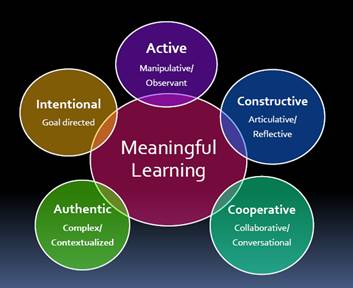
  • Consider what it is to have a “meaningful learning experience.” Your goals for online classes should be the same as they would be in a traditional class. Reflect on how people learn, think about pedagogical theories and principles, and develop the class.

Section13_clip_image002

In order for meaningful learning to occur according to Jonassen, Howland, Marra and Crismond (2008), the task that students pursue should engage active, constructive, intentional, authentic, and cooperative activities. Rather than testing inert knowledge, educators should help students to learn to recognize and solve problems, comprehend new phenomena, construct mental models of those phenomena, and given a new situation, set goals and regulate their own learning (learn how to learn) (p. 2). (For more, visit this site.)

  • Strive for presence, according to Bill Pelz.

    When participants in an online course help establish a community of learning by projecting their personal characteristics into the discussion — they present themselves as “real people.” There are at least three forms of social presence: • Affective — The expression of emotion, feelings, and mood • Interactive — Evidence of reading, attending, understanding, thinking about other’s responses • Cohesive — Responses that build and sustain a sense of ‘belongingness’, group commitment, ore common goals and objectives

  • Work with your university’s online and digital learning teams. Consult with instructional designers.
  • Don’t feel bad. You will mess up the first time. You may have an awkward, clumsy experiment the first time. However, we all teach what we don’t know in our traditional teaching lives. The same applies to online learning, according to this author. As these authors noted: “Both faculty and students must recast their traditional teaching and learning methods to benefit from this..instructional model…Instructors can create very effective and flexible teaching environments with hybrid courses. However, to do so successfully, instructors must learn new skills.”

Internship & Scholarship Opportunity: Atlanta Tribune Magazine’s George A. Lottier Golf Foundation Internship and Scholarship Award

Atlanta Tribune: The Magazine is currently accepting applicants for our George A. Lottier Golf Foundation Internship & Scholarship Award.

The internship is open to any college student entering his or her junior or senior year, or anyone pursuing a graduate degree. Applicants must have a minimum 3.0 GPA and be studying Graphics, English, Journalism, Communications, Marketing or Sales as their major or area of concentration with an emphasis in print media.

The scholarship amount of $1,500 will be awarded to one winner. The winner will also work an internship at Atlanta Tribune: The Magazine and possibly receive a monthly transportation stipend. The winners will be notified by an Atlanta Tribune: The Magazine staff member and will begin their internship within three weeks of notification. The internship spans 10 weeks.

The attached George A. Lottier Golf Foundation Internship & Scholarship Award application packet details the materials that must be submitted for consideration.

Should you need any further information, please do not hesitate to contact me at (770) 587-0501, ext. 210, or at internships@atlantatribune.com.

Katrice L. Mines
Editor

Job Opportunity: Lecturer of Public Relations, School of Communication and Media, Kennesaw State University

Lecturer of Public Relations

School of Communication and Media

Kennesaw State University is now accepting applications for a nine -month, non-tenure track Lecturer of

Public Relations in the School of Communication and Media, which begins August 2016. Candidates

should possess expertise in design including Adobe Creative Suites. Responsibilities will include teaching

courses in the public relations curriculum. An earned M.A. in Communication (or related discipline) or

M.F.A., or its foreign equivalent is required, and professional experience in public relations is strongly

desired.

For more than 50 years, Kennesaw State University has been known for its entrepreneurial spirit and sense

of community. Offering campuses in Marietta and Kennesaw, the university is located just north of Atlanta

and combines a suburban setting with access to one of the country’s most dynamic cities. As Georgia’s

third-largest university, Kennesaw State offers more than 100 undergraduate and graduate degrees,

including a growing doctoral program. Designated by the Board of Regents of the University System of

Georgia as a comprehensive university, Kennesaw State is committed to becoming a world-class academic

institution positioned to broaden its academic and research missions and expand its scope on a local,

regional and national level.

Review of applications will start immediately and will continue until the position is filled. For full

consideration, completed applications should be submitted by November 15, 2015. For a full

description of this position and application procedures, go to https://facultyjobs.kennesaw.edu.

Kennesaw State University, a member of the University System of Georgia, is an Equal

Opportunity/Affirmative Action employer and does not discriminate on the basis of age, color, disability,

national origin, race, religion, sex, sexual orientation, and/or veteran status. Georgia is an Open Records

state.

For #PRProfs Who Have Considered Quitting When Their Academic Unit Isn’t Enough

I was tempted to title this blog post “Making a Way Out of No Way When No One in Your Department Gives A Damn,” but that title was too long to tweet. I could have titled this with that header or its runner-up, “Surviving in a Shitty-Ass, Resource-Fucked Department is Not For the Pusillanimous Professor.” However, I decided to reign in the cursing because:

  1. the title is too damn long, again #academicscantkeepthingsshort
  2. this is a SFW (suitable for work) blog. #sfw
  3. my mother and grandmother might read this and attempt to wash my mouth out with soap. #politicsofrespectability #respectyourelders
  4. I may be on the job market in the near future. #thenewacademicreality

I may curtail my swearing, but I will not mince words or cut corners. This is a blog post that’s been brewing for months, no years, for me. After days months  years of putting in valiant efforts to make significant (curricular, structural, and policy) changes in my area, I have come to realize that my efforts have been in vain. For six years, I’ve laid groundwork and pushed my agenda only to realize that it was futile.

I’m just here in a department that could be great at much but chooses to be mediocre in most things.

As a student told me recently, “You know everything but don’t give a darn about any thing.” That’s the recent truth of my life. At one time, I cared. I lamented and wailed. I sat in ashes and scribbled out plans to rebuild crumbling program. I conducted SWOT analyses to make arguments and decisions; I “boobytrapped my house [my university office] with corporate resources” such as SWOT analyses and scenario building tools. I interviewed students, surveyed students, analyzed and took over the social media channels, and asked my student groups to deliver solutions. I was a worker bee, intent on making the hive’s queen bee ecstatic that the program I was hired into was being of value.

That was then. This is now, and my now is full of resignation. My department is not going to change. Instead, it is going to charge stubbornly into the future. In fact, I wrote the following during a heated discussion about a theory class taught without context, clarity, or application to undergraduates:

“What will it take to change the PRcurriculum?” Me: An act of God, 5 retirements, the realization that PR isn’t journalism

Honest to goodness, this antiquated PR and journalism curriculum was probably chiseled into rocks when the dinosaurs roamed the earth.

[If you haven’t realized it already, I’m a hoot on the Twitter. Follow me.]

I am still waiting on the act of God to break out my area from journalism. I am still waiting on these retirements so the department could hire a tenure-track person in my area since 1/2 of the majors are PR focused. I’m cranky because I’m toiling away in a subpar department that lacks vision, resources, a clear idea of what public relations education is, and the true understanding of what a capstone course is.

This situation sucks, but I’ve held on because I believed that time and maturation could solve the problem. I believed that if I stayed here, things would get better.

Poppycock. Balderdash. Utter inanity and complete nonsense.

Let me offer some words of advice to those faculty who are in such departments where their time, talents, enthusiasm, and vigor have been ground out of them because they are intellectually isolated, academically misaligned, and/or politically outmanned:

  • Read this piece by David D. Perlmutter and cogitate on this nugget below. Think about what signs you missed. Drink copious amounts of wine (or eat multiple pieces of chocolate). Listen to the new Adele song, weep for your past and present, and hug a pillow.

being on the tenure track somewhere is almost always better than being unemployed, but that doesn’t mean you should accept an offer impetuously. A tenure-track position is a potential lifetime commitment. Don’t walk into the relationship so giddy with relief that you neglect to be alert to any danger that may await you.

  • Run as fast as you can. As Descartes said, “Perfect numbers like perfect men are very rare.” The same is true for academic units, but you can find one that aligns with your vision, your purpose, ACEJMC accrediting standards, and whatever guidelines you have. Interview and go beyond the surface level questions. Find your fit. (Again, re-read the David Perlmutter piece and be conscious of the warning signs.)
  • If you have to stay in such a location, pick your hills. In academia, we give equal weight to all the dilemmas we face. Enrollment management gets fought with the same fervor and tenacity as discovering who keeps stealing the good coffee from the 9th floor kitchen. Rather than putting fruitless effort into the endless and sometimes tautological arguments, you have to analyze the field. Know the people in your department; understand the crux of this beef and how long this beef has been going on. If this fight has been cycling through the department when Fatty Arbuckle was still a popular comedian, then don’t get involved. My strategy has been asking the question “Is this the hill I am willing to die on?” For most matters, no. The argument over the coffee, yes.
  • Stay in your lane and focus on the things you can control. The myth of the academic meritocracy destroys any belief that you “control” your academic life and that you have “freedom” and “flexibility.” You may not be able to control your class schedule or meeting schedule, but you can control how you work and what you are working on. Focus on the positive things within your power (if you have that).
  • Find other people like you. If you are isolated in your department, find your tribe elsewhere. The beauty of this moment in time is that we have social media where we can find communities of refuge on Facebook, Twitter, Yammer, Academia.edu, etc. Go there and be renewed. Start collaborating with those people. Find your safe space and group where you can vent and share success stores. We all need our people and our community.
  • Find other things to think about and do. After work, there’s no need to be depressed about the awful life choices you made when you signed that contract or get upset (again) about the snarling associate dean who throws academic grenades into your department just for fits and giggles. Leave the job at the job. Get a hobby. Get a life. Don’t talk about work outside of work.
  • Seriously, dust off the CV and go looking for another job.
  • Lay low. Don’t get too invested in people, places, or things. Do your work and practice strategic incompetence if you are privileged enough to do so.
  • Don’t talk about the issues with people in the department. There are three types of people in this department: the unwashed, untenured masses who are furiously trying to get to the land of milk and honey and prefer to remain mute in all policy discussion; the bitter, jaded tenured professors who are squashed by the demands of the senior faculty to do more service and cannot commit to anything else; and the senior faculty who are heavily invested in an outdated curriculum. You can’t trust anyone in these groups to have an honest conversation with you. Your words may be used against you at another point in time, so watch what you say.
  • Treat the politics and policies of the job the way you would treat a bad boyfriend. Read Amy Poehler’s chapter on this. Work hard at what you do–the teaching, the research, and “the service”, but don’t get caught up in the outcomes. Don’t expect people to be enamored with your ideas or your work ethic, especially if those are contradictory or noncompliant with the trajectory of your subpar, nonfunctioning department. As she wrote, “If your career is a bad boyfriend, it is healthy to remember you can always leave and go to sleep with somebody else.”

Remember Amy’s advice: “You can always leave and go to sleep with somebody else.” You can always leave. You don’t have to continue sleep(walking) though life in a subpar department.

Communications Aide, Georgia State Senate Press Office, Atlanta, Ga.

GEORGIA STATE SENATE PRESS OFFICE

Communications Aide Job Description

2016 Legislative Session

The Georgia State Senate Press Office is currently looking to fill two (2) Aide positions for the 2016 Legislative Session of the Georgia General Assembly. This is a temporary, full-time paid position that will run from mid-January to April. Responsibilities of the Senate Press Office Aide include:

  • Compiling daily news clips
  • Answering and directing phone calls (screen, take messages, transfer calls for staff)
  • Accurately recording bill recaps and vote counts
  • Writing and editing a “Week in Review” document for Senators and legislative staff
  • Drafting press releases
  • Uploading web content
  • Maintaining and updating media lists
  • Assisting with press conferences
  • Identifying and brainstorming communications strategies with SPO staff
  • Attending and recording committee meetings when necessary for SPO staff
  • Monitoring social media sites and drafting editorial plans and strategy
  • Assisting in weekly tapings (scripts) and assist with video editing
  • Providing research support on a wide range of other issues as needed

Candidates must have strong written communication skills, knowledge of communication strategy andfamiliarity with social media plans. Preference will be given to candidates with PR, Communications, Political Science or Professional Writing backgrounds. Please send resumes, three (3) writing samples and references to adam.sweat@senate.ga.gov by Friday, November 20.

The Senate Press Office is the official press and media relations office for the Georgia Senate. This office does not produce campaign-related materials, write campaign speeches, or participate in other campaign-related or partisan activities beyond the scope of the day to day duties.

For information on the Georgia State Senate’s paid/college credit intern program, visit http://www.legis.ga.gov/intern/en-US/default.aspx.

Finally, A Name for the Blog: Six Impossible Things Before Brunch

The name came to me in my sleep. Well, not the name, but this passage from Alice in Wonderland:

“Alice laughed: “There’s no use trying,” she said; “one can’t believe impossible things.”
“I daresay you haven’t had much practice,” said the Queen. “When I was younger, I always did it for half an hour a day. Why, sometimes I’ve believed as many as six impossible things before breakfast.”
Alice in Wonderland.

Six impossible things before breakfast was taken, so I decided on switching out breakfast for my favorite meal of the day: brunch.

Thus, the final name for this blog will be Six Impossible Things Before Brunch.

I feel accomplished…until I start tinkering to change the name of the blog in WordPress. Bear with me while I work on that.