Journal of Communication Inquiry Call for Papers

Journal of Communication Inquiry – Call for Papers

Special issue on Digital Feminist Media Studies

The Journal of Communication Inquiry invites submissions for the October 2016 special issue on topics incorporating critical cultural approaches to the intersection of user-generated culture and feminisms.

Recent media and communication scholarship has assessed the multiple and complex avenues of interaction between user-generated content and various feminisms—Black feminisms, transnational feminisms, postfeminisms—to highlight the impact of cultural production on users. Feminist scholarship acknowledges that beliefs, practices, and communities online are articulated in an online cultural landscape that demonstrates the vitality of gendered ways of thinking and living in a mediated world, as well as how online media shape and inform feminist philosophies.

A critical cultural approach to online media and feminisms is suited to emphasize emergent notions of meaning, power, and identity across online communities. JCI welcomes submissions that engage these intersections within theoretical and methodological approaches utilizing critical, cultural, and historical perspectives. Studies based in feminist epistemologies are welcomed, especially those committed to social transformation research.

Possible topics of inquiry are vast but could include:

Cyberstalking; online bullying; hacking; surveillance
Postfeminism and online entrepreneurship
Gamergate and online misogyny
Online activism and ‪#‎everydaysexism‬
Blogging, branding and class
Gendered disability and online organizing
Transnational identity and YouTube
Online sexual identity and popular culture
Gaze and online sex work
Female racial performance and social media
Selfies and authenticity
Indigenous cultures and online identity
Black feminism and digital music
The deadline for submitting manuscripts is 11:59 p.m. CST on February 15, 2016. Please contact Managing Editor Andrea Weare (jci@uiowa.edu) with questions.

Best Practices in Ethics in an Emerging Media Environment

Best Practices in Ethics in an Emerging Media Environment
A teaching competition sponsored by the AEJMC Elected Standing Committee on Teaching
Deadline: Entries should be received by 5 p.m. Eastern Time, March 20, 2016
For the 11th year, the AEJMC Elected Committee on Teaching is looking to honor innovative teaching ideas from our colleagues. Each year, the committee selects three winners in a themed competition highlighting different areas across the journalism and mass communication curriculum.
The 2016 Best Practices competition will focus on Ethics in an Emerging Media Environment; we seek entries that explain how you have used innovative learning techniques and systems to teach ethics in this ever-changing media world with new delivery formats and content. This area is broad, and ideas are welcomed from all disciplines represented among our membership. Teaching areas appropriate for this competition include, but are not limited to, media and society; print, broadcast, reporting and editing; public relations; advertising; media law; media ethics; visual communication; and photojournalism.
The AEJMC Teaching Committee will select winning entries for publication in our ninth annual AEJMC Best Practices in Teaching competition that will be published in an e-booklet. Winners are required to share their entries during a teaching session at the AEJMC annual conference in Minneapolis on Aug. 4-7, 2016. Winners also will receive certificates and a cash prize: First: $300, Second: $200, Third: $100. Honorable mentions may also be awarded, but no cash will be provided for those entries.
Submission Guidelines
Your entry must be in one single Word file (.doc or .docx) or Text (.txt) file. PDFs will not be accepted as we need text files to facilitate publication of the e-booklet containing the winning ideas.
The first page of your entry should be a cover sheet with name, affiliation, contact information, entry title and a 125-word bio (written in third person). We will delete this cover sheet when we combine entries to facilitate blind judging. Do not include author name or any other identifying information in the description section of your entry.
The description section of your entry should be a TWO-PAGE executive summary and should include:
Title
100-word abstract
Explanation of the teaching practice or activity
Rationale
Outcomes
Under no circumstances should the description exceed two pages in 12-point type with one-inch page margins.
You may include up to two additional pages in the Word or Text document with examples of student work or other supporting materials. However, the entire entry should not exceed five pages and must be in a single Word file with no identifying information other than on the title page.
Submit your entry as an attachment by email to Chris Roush atcroush@email.unc.edu. (The subject line should be “2016 AEJMC Online Teaching (YOUR NAME).”) Copy the e-mail entry to yourself as proof of submission.
Confirmation of entry receipt will be sent via e-mail within 48 hours of your submission. If you do not receive this, please call Chris Roush at 919.962.4092.
Criteria for Judging
The criteria to evaluate entries are outlined below:
Relevance of entry to the theme of Ethics in an Emerging Media Environment (10 points).
Creativity or innovation (30 points).
Real-world applications of relevant teaching theories, concepts and principles (15 points).
Interactivity and evidence of active and collaborative learning techniques (25 points).
Compliance with format in Call for papers (10 points): (i). Explanation of teaching/methodology, (ii). Rationale, and (iii). Outcomes
Overall impression or assessment (10 points)
Judging
The AEJMC Teaching Committee’s panel of judges will decide the winners. All entries will be blind judged. Judges will not have access to any identifying information about entrants. The judges reserve the right not to award prizes. Competition results will be announced by April 30.

Call for Lesson Plans for Teaching Media Quarterly: Teaching #BlackLivesMatter: Media, Race, and Social Movements (Vol. 4, No. 1)

As seen on the National Communication Association E-mail list

From Heidi Zimmerman (zimme313 at umn dot edu)

Call for Lesson Plans for Teaching Media Quarterly: Teaching #BlackLivesMatter: Media, Race, and Social Movements (Vol. 4, No. 1)

Submission deadline: January 11, 2016

Black historical experiences are never past, but always permeating the present. The mediated Black Lives Matter movement can be seen as a fissure in the narrative of American exceptionalism demanding recognition of the current and historical dehumanization of Black bodies. In the seventeenth century, slaves transported to the American colonies endured torture, rape, and daily terror. Slave labor produced the wealth of the colonies and the United States, in both the South and the North. The Black Codes of the Reconstruction era, including the newly written vagrancy laws, imprisoned the unemployed into chain gangs, which in turn were sold to the highest bidder to work in agriculture and mining, and to rebuild the South (Blackmon 2008). In the era of Jim Crow, Black Americans endured the separate but equal doctrine, which provided them with substandard schools, healthcare, and housing, and required rigorous abiding by segregation laws (Massey & Denton 1993); failure to do so wa!
s met by state-sanctioned and Ku Klux Klan violence, rape, murder, and economic terrorism (Wells-Barnett 1892, 1895). The second half of the twentieth century saw urban renewal programs and white flight to the suburbs depleting the tax base of largely urban communities, the disappearance of industrial jobs, redlining in housing, gerrymandering of voting districts, broken windows policing, the militarization of the police, and the mass incarceration of Black, Latino, and Native American populations (Hirsch 1998; Freund 2007; Slater 2010; Sugrue 2014; Alexander 2010; Thompson 2010).

Media have been crucial in these historical developments. Whites have traditionally employed print, radio, and television media to justify state and extrajudicial violence against Blacks, to promote segregation and disenfranchisement, and recently to popularise narratives of personal responsibility removed from a historical understanding of structural white supremacy. Some scholars have examined narratives about the state of race relations and representations of Blacks and whites (Stabile 2006; Hill Collins 2000; Smith-Shomade 2002; hooks 2006). Others have researched how Blacks have taken control of the means of media production, and have employed the media to form counterpublics to communicate internally and to counter dominant white supremacist rhetoric (Heitner 2013; Savage 1999; Smith-Shomade 2007; Squires 2000, 2002, 2012; Morris 2015).

In this historical context of state, economic, and cultural violence, as well as the current epidemic of police brutality and the mass killings of Black and brown people in the United States, it is of utmost importance to cultivate teaching strategies that help undergraduate students develop critical tools for understanding the ways in which the media operate vis-à-vis social movements. Black Lives Matter is currently one of the most important social movements in the U.S. It links police brutality, mass incarceration, the dehumanization of Black and brown bodies to political and economic policies rooted in white supremacist thought. Participants in Black Lives Matter organizing, protests, and marches have repeatedly employed social media-Twitter in particular-to organize and coordinate. They have also used media to present Black experiences of state violence commonly dismissed by mainstream media. Participants in the Ferguson and the Baltimore Uprisings called out mainstream!
media for misrepresenting the protests, presenting socio-economic conditions in simplistic “thug” narratives, and for titillating audiences at home with footage of burning buildings and violence, whilst ignoring the actual grievances and daily experiences of Black Americans.

Although there are several online resources to teach about the Ferguson Uprising and Black Lives Matter designed for the High School curricula, we are looking for lesson plans for the undergraduate classroom that focus on the intersection of Black Lives Matter and the media, especially in relation but not limited to:

– Communication and organizing via social media platforms

– The political economy of Black Lives Matter

– Building social movements under neoliberalism

– #SayHerName and the visibility of Black women murdered by police

– Framing of Black Lives Matter in mainstream media and counter-framing by protesters

– Counterpublics and social movements

– Mediated racial discourses, discourses of colorblindness, and the politics of representation

– Historical perspectives on media representations of Black opposition to state violence

Teaching Media Quarterly Submission Guidelines

All submissions must include: 1) a title, 2) an overview (word limit: 500 words) 3) comprehensive rationale (using accessible language explain the purpose of the assignment(s), define key terms, and situate in relevant literature) (word limit: 500), 4) a general timeline, 5) a detailed lesson plan and assignment instructions, 6) teaching materials (handouts, rubrics, discussion prompts, viewing guides, etc.), 7) a full bibliography of readings, links, and/or media examples, and 8) a short biography (100-150 words).

Please email all submissions using the TMQ.Submission.Template (2) (.docx) in ONE Microsoft Word document to teachingmedia.contact@gmail.com.

Review Policy

Submissions will be reviewed by each member of the editorial board. Editors will make acceptance decisions based on their vision for the issue and an assessment of contributions. It is the goal of Teaching Media Quarterly to notify submitters of the editors’ decisions within two weeks of submission receipt.Teaching Media Quarterly is dedicated to circulating practical and timely approaches to media concepts and topics from a variety of disciplinary and methodological perspectives. Our goal is to promote collaborative exchange of undergraduate teaching resources between media educators at higher education institutions. As we hope for continuing discussions and exchange as well as contributions to Teaching Media Quarterly we encourage you to visit our website at http://www.teachingmedia.org/
Job Opportunity: Legislative Assistant (temporary), Fulton County Government (Atlanta)

FULTON COUNTY / JOB VACANCY 12/9/15
PERSONNEL DEPARTMENT (404-613-6700)
          141 PRYOR STREET, SUITE 3030, ATLANTA, GA 30303
       COMPETITIVE JOB ANNOUNCEMENT     15-1234
 
                      LEGISLATIVE ASSISTANT    TITLE CODE: 101133
Hourly rate: $24.68
 
THIS IS AN UNCLASSIFIED, TEMPORARY AND SEASONAL POSITION IN THE EXTERNAL AFFAIRS DEPARTMENT.
(employment for this recruitment will be no more than 29 hours per week)
 
QUALIFICATIONS:
Bachelor’s degree in business or public administration, political science, or a related field; and two (2) years experience in governmental operations, including experience planning and organizing meetings, conducting community relations, or related experience; or a year for year interchange of indicated education and experience equal to the minimum qualifications.
LICENSING REQUIREMENTS:
Valid State of Georgia Driver’s License or proof of mobility equivalent may be requested.
 
EXAMINATION:
The examination process will include the following: application review and evaluation to establish a rating to reflect Qualified or Not Qualified. Application must document that the applicant possesses the minimum knowledge, skills, education and experience as listed. If selected, an official, accredited college transcript is required, at time of employment, for all degrees/course work used to qualify for this position.
TO APPLY:
Online application available at the county’s web page:  www.fultoncountyga.gov. and completed Fulton county application forms will be accepted at the Personnel Department. (address above) applications must be completed in full before they are submitted. please review all applications for accuracy and make all corrections before submittal because errors can result in not meeting the minimum qualifications.  additional information will not be accepted after applications have been received by the Personnel Department.
CLOSING DATE:
DECEMBER 12, 2015
 
IT IS THE POLICY OF FULTON COUNTY THAT THERE WILL BE EQUAL OPPORTUNITY FOR EVERY CITIZEN, EMPLOYEE AND APPLICANT, BASED UPON MERIT WITHOUT REGARD TO RACE, COLOR, RELIGION, NATIONAL ORIGIN, GENDER, AGE, GENETICS, DISABILITY OR SEXUAL ORIENTATION.
 
JOB SUMMARY/ DISTINGUISHING CHARACTERISTICS/ ESSENTIAL DUTIES (REPRESENTATIVE SAMPLE)/ KNOWLEDGE AND SKILLS:
Incumbent in this class performs duties related to providing research and legislative support and analysis for Fulton County delegations, elected officials, and citizens. 
 
This is the first level within a four-level legislative professional classification series.  Legislative Assistant is distinguished from Legislative Officer in that the former assists the State House or Senate delegation by coordinating various administrative responsibilities for the delegation chairperson, whereas the latter reviews and edits position papers for pending legislation in addition to performing legislative research and attending committee hearings and delegation meetings.
 
Assists the State House or Senate delegation in developing an annual legislative program. Establishes and maintains legislative clearinghouse services for citizens, governmental bodies, and delegation members. Collaborates with an assigned legislative team in the development of strategies. Coordinates legislative meetings for an assigned delegation. Attends various legislative and community meetings. Assists executives and assigned staff in promoting intergovernmental relations and Fulton County’s interests.
 
Office practices and procedures; Local governmental operations; Principles and practices of customer service; Methods and techniques used to conduct legislative research and analysis; Laws, rules, and regulations governing lawmaking, lobbying, and intergovernmental relations; State and local legislative processes; Personal computers and related software.
 
Planning, organizing, and implementing community projects; Providing effective customer service; Managing multiple projects simultaneously; Monitoring and tracking legislation; Conducting legislative research and analysis; Conducting effective lobbying efforts for various governmental legislation; Preparing and presenting oral and written communications/reports; Maintaining detailed reports and files; Operating personal computers, including spreadsheet, database, word processing, presentation, and other related software; Establishing and maintaining effective working relationships with other County personnel, officials, and the general public; Communication and interpersonal techniques as applied to interaction with coworkers, supervisor, the general public, etc., sufficient to exchange or convey information and to receive work direction.

Internship: Race for the Cure intern, Susan G. Komen, Atlanta

Race for the Cure Intern

Reports to: Julie Brock

Position Status: Intern (unpaid)

Time Commitment: 15-20 hours per week thru May 7th required; May 31, 2015 preferred.

About Susan G. Komen®

Nancy G. Brinker promised her dying sister, Susan G. Komen, she would do everything in her power to end breast cancer

forever. In 1982 that promise became Susan G. Komen® and launched the global breast cancer movement. Today,

Komen is the world’s largest grassroots network of breast cancer survivors and activists fighting to save lives, empower

people, ensure quality care for all and energize science to find the cures. The Greater Atlanta Affiliate, established in

1991, is one of 114 Affiliates in the U.S. and Europe. In 2015, Komen Atlanta invested over $1.5 million in grants to 16

local organizations funding lifesaving education, patient navigation, treatment support and treatment programs in our

fifteen county service area. Since 1991, Komen Atlanta has invested over $41 million in local programs, funding

potentially lifesaving services for underserved individuals.

Position Overview & Basic Function:

The Race for the Cure Intern will assist with various projects focused on our Race for the Cure event. The content will

revolve around the area of special events, with opportunities to assist with event logistics, database management,

mailings, social media marketing, sponsorship fulfillment, and gamification while responding to inquiries from the public

about the Affiliate’s Race for the Cure event.

Primary Responsibilities:

 Assist Race Manager with event logistics, details, and planning for the Komen Atlanta Race for the Cure on

5/7/16

 Track vendor information and event equipment.

 Respond to event correspondence.

 Assist with Race participant recruitment which may include assisting in marketing strategies as well as

contacting targeted Race participants via email/phone to cultivate relationships.

 Other duties as assigned.

Required Skills & Education:

 Must be able to attend the Komen Atlanta Race for the Cure on Saturday, May 7, 2015.

 Excellent communication, customer service and interpersonal skills.

 Strong time-management, organizational and research skills.

 Quick learner with the ability to self-motivate.

 Have strong computer skills, including strong experience in Microsoft Offices (i.e. Word, Excel)

 Must be enrolled as an undergraduate or graduate student or be a graduate of a college or university

Other:

 Ability to lift / carry 30 pounds; capable of standing for one hour or more.

 Position will need to use their personal computer.

 Candidate may be subject to a criminal background check.

Benefits:

 Opportunity to gain insight into the not-for-profit sector.

 “Hands-on” environment with individuals who respond to critical community issues.

 Develop above-entry-level skills.

To apply for the internship, email a resume and writing sample to Trista McGlamery at tmcglamery@komenatlanta.org.

Public Affairs Intern, CTIA-The Wireless Association, Washington, DC

Public Affairs Intern, CTIA-The Wireless Association, Washington, DC


PUBLIC AFFAIRS INTERNSHIP PROGRAM


DESCRIPTION:

CTIA-The Wireless Association (www.ctia.org) represents the U.S. wireless communications industry. With members from wireless carriers and their suppliers to providers and manufacturers of wireless data services and products, the association brings together a dynamic group of companies that enable consumers to lead a 21st century connected life. CTIA members benefit from its vigorous advocacy at all levels of government for policies that foster the continued innovation, investment and economic impact of America’s competitive and world-leading mobile ecosystem. The association also coordinates the industry’s voluntary best practices and initiatives and convenes the industry’s leading wireless tradeshow.


Headquartered in Dupont Circle in Washington, DC, CTIA is offering one college student (undergrad or graduate) or recent graduate the opportunity to gain experience working for a dynamic trade association.


CTIA’s Public Affairs team works with our Regulatory Affairs, Government Affairs, External and State Affairs on many policy issues. We also work with the industry’s non-profit organization, The Wireless Foundation, on various matters.


The intern would be an integral part of the Public Affairs team, assisting with tasks including coordinating and staffing events, writing press releases, writing blog posts, developing online content and tracking industry-focused news and events.


REQUIREMENTS:

Applicants must have completed their junior year of undergraduate study and have at least a B average. Applicants studying from all major areas are welcome, but academic or practical backgrounds in journalism, mass media, communications, public relations, public affairs and radio and television broadcasting are preferred.


COMPENSATION AND HOURS:

Interns should be available at least 4 days a week and for at least 25 hours per week for college credit only.


APPLICATION:

Please send a cover letter, including your availability (start dates and weekly schedule), resume, three different writing samples (no more than 3 pages each and should demonstrate concise writing ability), two letters of recommendation and college transcript to: CTIAMedRel@ctia.org or


Public Affairs Intern Application

CTIA-The Wireless Association

1400 16th Street NW Suite 600

Washington, DC 20036


Applicants must be available beginning in January to May 2016. All application should be in CTIA Public Affairs’ office by December 11, 2015 at 5 PM ET.


Incomplete applications will not be considered. No phone calls please. CTIA will contact candidates directly. Decisions will be made within 1-2 weeks of the application deadline.

A Response to the Washington Post article, “It’s 2015. Where are all the Black college fy aculty?”

Here is the article if you haven’t read it.

Black faculty are here. We’re not mythical unicorns.  Some are the walking wounded. Some are the successful few who have navigated the university politics to make it to full. Some black faces appear in the slick university brochures. Others toil behind the scenes, not quite sure if they are noticed and hoping that they aren’t.

But we are here. You might not see us for the following reasons:

We’re probably in diversity meetings called by the dean or provost that will lead to nothing but lost time and increased aggravation.

We’re probably frustrated and marginalized. We’re probably not on tenure track.

We might be in a hiring committee meeting, only to see certain candidates declared as “not a good fit for the department.” We might be asked to recruit people of color to apply for these faculty lines to “get our diversity numbers up.”

We could be seeking out other professors of color on campus, just to see a friendly face or another brown or black face on campus. And many of us fail at that task.

We’re probably working with the students of color who were left behind in the graduate program because they considered deficient by faculty. We’re sponsoring and mentoring those who were left to wither on the vine.

We might be mentoring an endless stream of students who seek you out because you are a safe haven. We keep tissue, petty cash, candy, and a good word tucked away at all times just in case one of those students need it.

We may be grinding out the service work that counts for nothing but takes up so much time. We didn’t volunteer for this committee, but somehow we’re on it. We might be told by a department chair that since we’re good at that administrative stuff that we are a good fit for time-intensive, labor-filled service that will amount to one line of the CV and no goodwill from those making merit, tenure, and promotion decisions.

We probably aren’t focused on research as much as we like because of that other stuff. If we are research focused and we happen to do work on our community, we’re probably being told that it isn’t enough for tenure.

We’re likely dealing with classroom issues that have to deal with being black, being black and female, or being black and queer or disabled in the classroom.

We might be dealing with the structural racism, sexism, and other -isms that prop up the academy and dealing with the physical and mental toll that wears your body down.

We’re here, but we are occupied.

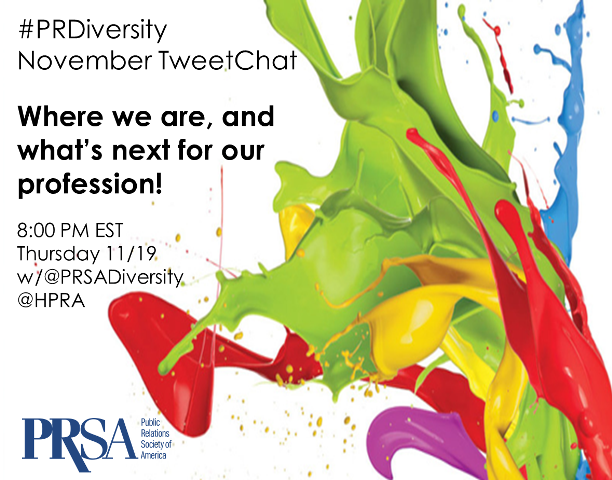
#PRDiversity November Tweetchat

‪#‎PRProfs‬ and #PRstudents, the Public Relations Society of America (PRSA) Diversity and Inclusion Committee and the Hispanic Public Relations Association are hosting a ‪#‎PRDiversity‬ Twitter chat on Thursday, November 19, at 8 p.m. EST. Share the word. Join in and tell your students to get involved in the conversation about what is the current state of diversity in the field.

diversity tweetchat

Diversity in Public Relations: It’s 2015, and we’re still talking about this?

A draft of this blog post sat in my box for months. I didn’t want to write this, but conversations at the PRSA International Conference made me feel like it was necessary to write this post.

I feel like I have talked about diversity in public relations for eons. That’s not true. It’s only been since I started graduate school at the University of Maryland that I began noticing and talking about the lack of diversity in the industry. That was 10+ years ago. Yet here we are in 2015 (almost 2016) still talking about this issue.

Example 1: This PRWeek cover of mostly white practitioners who are the top leaders of PR agencies frustrated me and others. As Shonali Burke points out:

A strong example of this can be seen on PRWeek’s 2014 Agency Business Report. While the publication’s effort to celebrate PR leadership and their innovation year after year is notable, it’s hard to ignore the lack of diversity on the front cover, which featured the most senior leaders at the top 13 agencies by revenue and the top two agencies by revenue growth in 2013.

While the decision to publish Caucasian-only faces as “PR leaders” may have been unintentional, the message conveyed is clear: “PR leaders” do not include people of color, minorities or of different ethnicity. At least not in 2014; and 2014 wasn’t light years away. It was just one year ago.

Scary. And sad.

Example 2: The release of the State of the PR Industry report from the National Black Public Relations Society. One of the claims that ran a chill down my spine was the fact that professional desire to have a sustained interest in career growth and advancement, yet do not have access to sponsors or see others like them in larger key roles. Breaking through is an obstacle course made up of glass ceilings, sticky floors, and porcelain/ceramic vaults because practitioners are contained in limited roles, have not moved beyond mentorship into sponsorship relationships, and are not exposed to new clients or new business opportunities. Dr. Rochelle Ford and Dr. Clarke Caywood bounced these findings off the work of Applebaum, Walton and Southerland (2015) and Hewlett and Green (2015).

Although the players have changed and the outlets where this matter is discussed have morphed, the conversation is still the same. The industry isn’t diverse. The industry has a retention problem. The industry has a recruitment problem. The industry has a problem. The industry should do something about it. The industry should start something to reverse these trends.

It’s the same verse of the same hymnal, sung by the same members of the choir to other members of the choir. We just change the riff and add a new falsetto every few times. I just hope that people from the congregation (our PR peers across all sectors and organizations) hear the choir, feel something swell up in their souls, and start to do something meaningful. As someone from Texas once told me, “they align the tongues in their shoes with the tongues in their mouths.”

I doubt that will happen until there is a sudden shift or movement. There must be something that jostles the industry out of its soporific stupor about diversity. A stringent call to action against the cognitive biases that frame and shape who gets into the door and who get asked to climb up the corporate trellis. A gauntlet tossed down. A final notice that the days of talk are limited. A strident challenge that calls out that the pipeline the industry leaders continually say is leaky has a flawed framework.

Maybe 2016 is the year for the movement to launch and to initiate a real call to action.

Maybe 2016 is the year when we stop talking about diversity within the same circles but push the dialogue to other.

Maybe something will pop off in 2016.

Until that time, I am going to pick up my hymn book to continue to sing while thinking of a master plan.

PRSA Educators Academy Super Saturday Thoughts

Today, I am presenting at the PRSA Educators Academy’s Super Saturday. My topics are service learning and online education. Here are some compiled thoughts that will guide my discussion.

Service Learning:

  • Service learning is pedagogy and a philosophy (Jacoby, 1996). It is learning that combines public service with related academic work.
  • Service learning has multiple definitions:

National Service-Learning Clearinghouse: Service-learning combines service objectives with learning objectives with the intent that the activity changes both the recipient and the provider of the service. This is accomplished by combining service tasks with structured opportunities that link the task to self-reflection, self-discovery, and the acquisition and comprehension of values, skills, and knowledge content.

Bringle and Hatcher: (1995): Service-learning is a credit-bearing, educational experience in which students participate in an organized service activity that meets identified community needs and reflect on the service activity in such a way as to gain further understanding of course content, a broader appreciation of the discipline, and an enhanced sense of civic responsibility.

American Association for Higher Education (1993): Service-learning means a method under which students learn and develop through thoughtfully organized service that: is conducted and meets the needs of a community and is coordinated with an institution of a higher education, and with the community; helps foster civic responsibility; is integrated into and enhances the academic curriculum of the students enrolled; and includes structured time for students to reflect on the service experience.”

American Association of Higher Education: Service learning means a method under which students learn and develop a thoughtfully organized service that: is conducted in and meets the needs of a community and is coordinated with an institution of higher education and with the community; helps foster civic responsibility; is integrated into and embraces the academic curriculum of the students enrolled; it includes structured time for the students to reflect on the service experience.

Lubbers and Gorcyca  (1997) listed 10 practices that encourage active learning in the classroom: (1) conduct of research projects; (2) field trips or volunteer activities; (3) student-initiated trips, projects, or activities; (4) role-playing and simulation in class; (5) relating outside events to class and theories, and (6) student challenge of ideas and course materials. Although

“a form of experiential education where learning occurs through a cycle of action and reflection as students. . . seek to achieve real objectives for the community and deeper understanding and skills for themselves. In the process, students link personal and social development with academic and cognitive development. . . experience enhances understanding; understanding leads to more effective action. — via https://cft.vanderbilt.edu/guides-sub-pages/teaching-through-community-engagement/

  • Sigmon’s Three Principles: These principles are the bedrock of service-learning principles:
    • Those being served control the service(s) provided.
    • Those being served become better able to serve and be served by their own actions; and
    • Those who serve also are learners and have significant control over what is expected to be learned.
  • If you work in an environment that is openly hostile to public relations and/or resistant to change (e.g., see my pinned tweet for an understanding of PR education at GSU), service learning may be the only way for your students to get meaningful experiences about public relations as well as a true understanding of how public relations can work for good.
  • Service learning can take multiple forms:
    • One-time project
    • Embedded optional course requirement
    • Optional course project
    • Project that stretches over multiple classes
    • Capstone project in one class
  • At Georgia State, given our student population, I have moved away from doing community-based service learning and opted for university service learning experiences.

Online Education and Digital Learning:

“E-learning is the use of information and computer technologies to create learning experiences” (Horton, 2006, p.1).

McVay and Roecker (2007) elaborate on this definition with the following addition, “E-learning is facilitated and supported through the use of information and communication technology, e-learning can cover a spectrum of activities from supported learning, to blended learning (the combination of traditional and e-learning practices), to learning that is entirely online” (p. 6). Learning is the critical element and objective regardless of the technology used.

  • We don’t have hybrid classes; we have hybrid learners.
  • A variety of online educational opportunities exist for educators to explore: fully online, hybrid, asynchoronous, synchornous, residency, blended, and flipped classrooms that incorporate experiential learning.
  • Some classes are beneficial for online/hybrid experiences. Other classes may not be.
  • We assume that students are “digital first” and “digital natives.” That may not be true about your student population. Also, you should consider the Internet access of your students (e.g., what devices they are using, what speed of Internet they have at home, where and how they access the Internet and class materials).
  • Online education isn’t just plopping your resources online, dusting your hands and walking away. You have to spend time recreating the class environment and reshape the roles. Online requires interaction and involvement from both the students and the instructors.
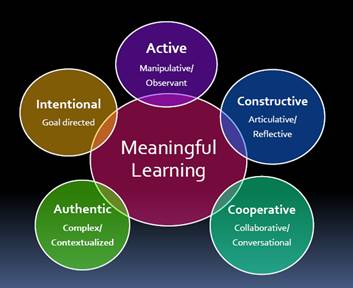
  • Consider what it is to have a “meaningful learning experience.” Your goals for online classes should be the same as they would be in a traditional class. Reflect on how people learn, think about pedagogical theories and principles, and develop the class.

Section13_clip_image002

In order for meaningful learning to occur according to Jonassen, Howland, Marra and Crismond (2008), the task that students pursue should engage active, constructive, intentional, authentic, and cooperative activities. Rather than testing inert knowledge, educators should help students to learn to recognize and solve problems, comprehend new phenomena, construct mental models of those phenomena, and given a new situation, set goals and regulate their own learning (learn how to learn) (p. 2). (For more, visit this site.)

  • Strive for presence, according to Bill Pelz.

    When participants in an online course help establish a community of learning by projecting their personal characteristics into the discussion — they present themselves as “real people.” There are at least three forms of social presence: • Affective — The expression of emotion, feelings, and mood • Interactive — Evidence of reading, attending, understanding, thinking about other’s responses • Cohesive — Responses that build and sustain a sense of ‘belongingness’, group commitment, ore common goals and objectives

  • Work with your university’s online and digital learning teams. Consult with instructional designers.
  • Don’t feel bad. You will mess up the first time. You may have an awkward, clumsy experiment the first time. However, we all teach what we don’t know in our traditional teaching lives. The same applies to online learning, according to this author. As these authors noted: “Both faculty and students must recast their traditional teaching and learning methods to benefit from this..instructional model…Instructors can create very effective and flexible teaching environments with hybrid courses. However, to do so successfully, instructors must learn new skills.”